Corporate Jet Los Angeles to Las Vegas
A corporate jet Los Angeles to Las Vegas covers 199 nautical miles in about 47 minutes. Turboprops quote at $2,200 to $3,500 for the one-way leg. This page covers airports, timing and what moves the quote.
- 199 nm229 sm
- 1h 00mturboprop duration
- $2,200–$3,500one-way quote
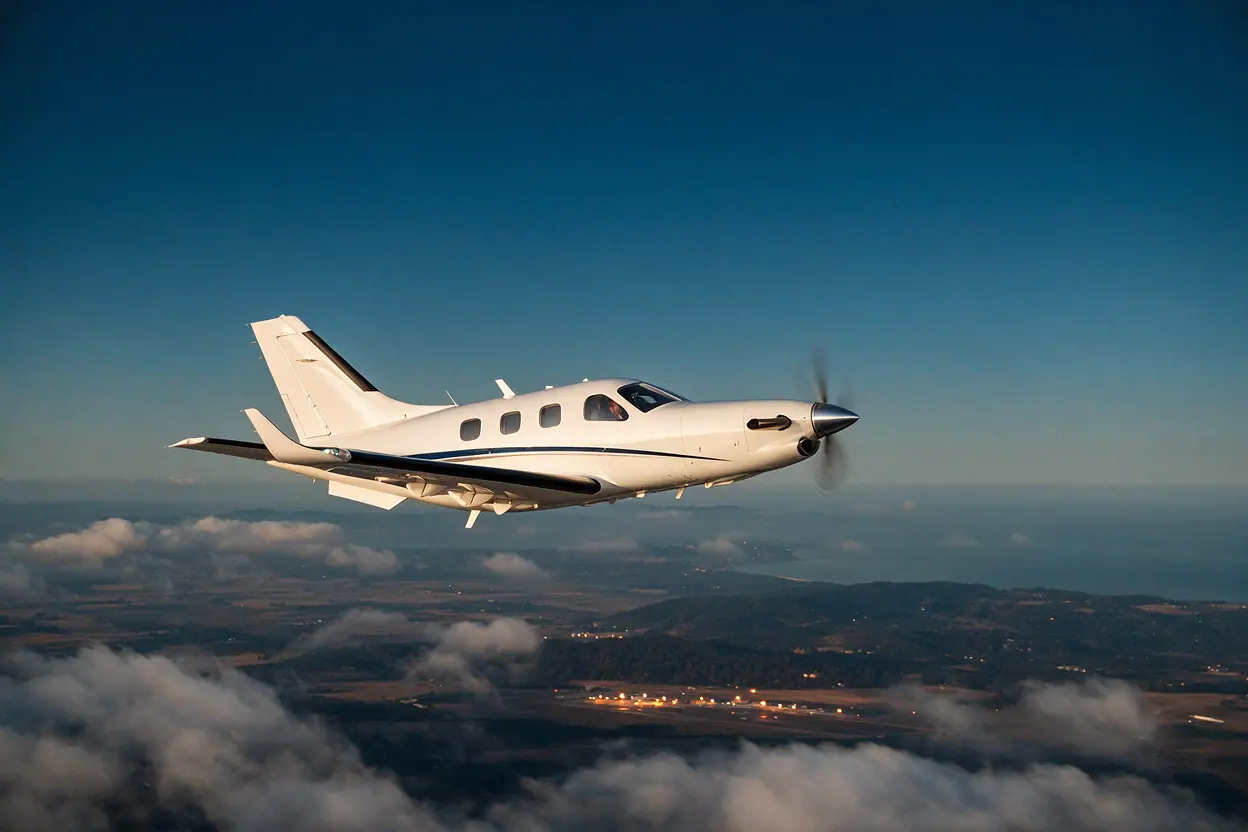
Aircraft pricing for Los Angeles to Las Vegas private jet
A private jet from Los Angeles to Las Vegas flies 199 nautical miles in 1h 00m on a turboprop, quoted at $2,200–$3,500 one way.Five classes clear this route nonstop, and the spread between them is narrow on time but wide on money. Below are block times and typical one-way estimates for each, drawn from current quotes on the 229-mile run over the mountains. Prices are estimates and firm up when you give dates, times and passenger count.
| Jet category | En route time | Single-leg est. | Detail |
|---|---|---|---|
| Turboprop | 1h 00m | $2,200–$3,500 | Preferred match |
| Light jet | 0h 47m | $4,000–$6,000 | Nonstop |
| Midsize jet | 0h 46m | $5,200–$8,000 | Nonstop |
| Super-midsize jet | 0h 45m | $7,200–$10,000 | Nonstop |
| Heavy jet | 0h 45m | $9,500–$14,500 | Nonstop |
Priced per aircraft, not per passenger, excluding federal excise tax and segment fees. Block time covers taxi, climb, and descent.
Airline ticket costs vs charter, Los Angeles–Las Vegas
Airline prices are the lowest fares Google Flights displayed for one passenger on Dec 9, 2026 (checked Nov 15, 2026); the charter row is our estimate for the entire aircraft. For 8 passengers, first class airline seat tickets total about $1,112, compared with $2,200–$3,500 for the whole turboprop.
| Way to fly | Operator | Dur. | Single-leg est. | Per seat |
|---|---|---|---|---|
| Coach on the airlines | Frontier · nonstop | 1h 16m | $19 | $19 |
| First class airline seat | Delta · nonstop | 1h 14m | $139 | $139 |
| Turboprop | Full plane, seating as many as 8 | 1h 00m | $2,200–$3,500 | $280–$440 |
Airline ticket prices shift daily and cover no bags past the fare allowance; the per-seat charter number assumes every seat is occupied.
How a turboprop suits this mission
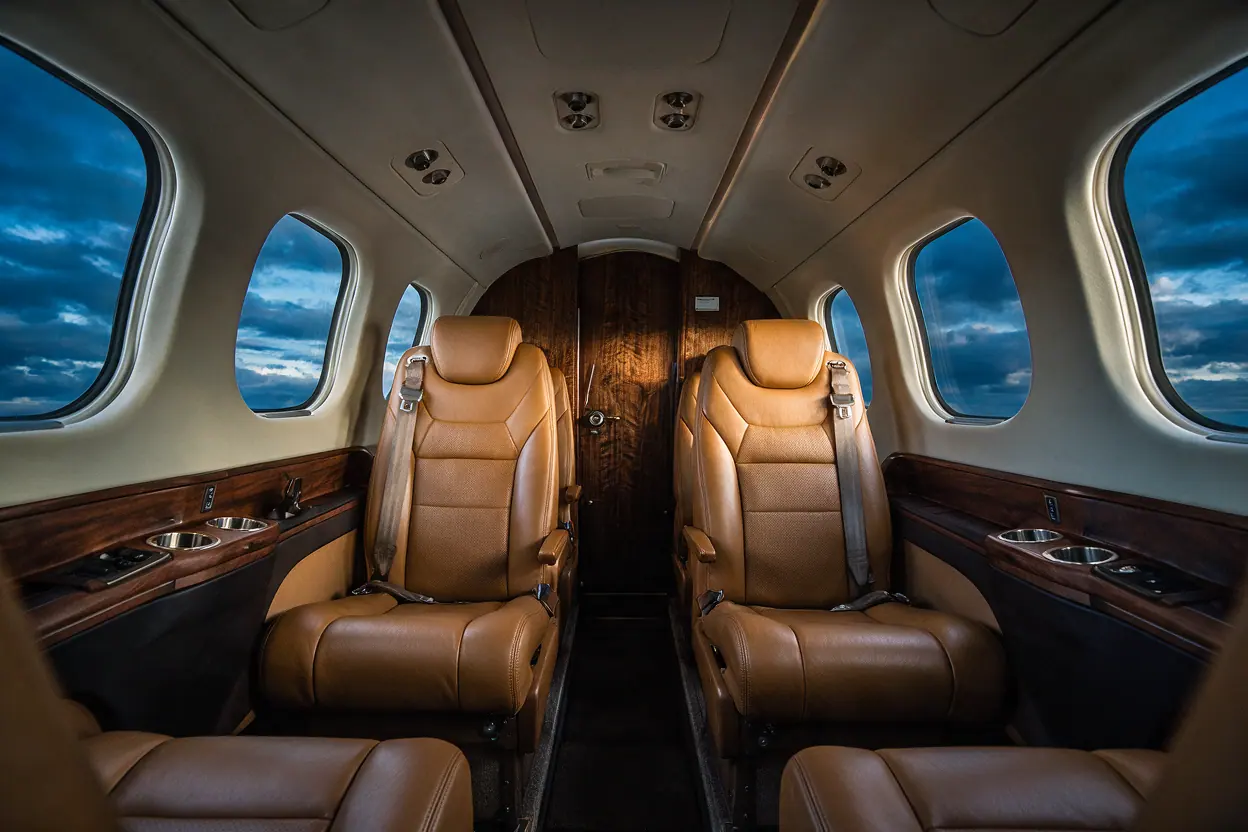
The turboprop is the sensible default here, which surprises people who assume jets only. At 199 nautical miles a Daher TBM 960 or King Air 350i cruises at 330 and 312 knots, so the jet's speed advantage never compounds into anything you notice. A turboprop runs the leg in about an hour while a light jet makes it in 47 minutes, and the turboprop quotes $2,200 to $3,500 against $4,000 to $6,000. That gap pays for a lot of Las Vegas ground transport. A turboprop carries six to eight on this 229-mile leg at the lowest estimate on the route and still lands nonstop.
If your party is six to eight with bags for a trade show floor, then the King Air 350i carries the group with 55 cubic feet of baggage and still lands inside the turboprop band. Step up to a midsize jet at $5,200 to $8,000 when the schedule needs a faster climb for weather routing, and to a super-midsize or heavy when you want a stand-up cabin or a rear lavatory for the return leg. Speed stops buying you time once a jet passes the turboprop on a hop this short so cabin size and baggage decide it, not knots. A light jet at $4,000 to $6,000 one way fits a team of five or six better when bag count forces the move.
Daher TBM 960
- 6 pax
- 330 kt speed
- 1,730 nm legs
Cabin size 4 ft tall, 13 ft 3 in long. Bags 32 cu ft.
Beechcraft King Air 350i
- 8 pax
- 312 kt speed
- 1,800 nm legs
Cabin size 4 ft 9 in tall, 16 ft 8 in long. Bags 55 cu ft.
When prices peak on this route
Demand on this corridor tracks the convention calendar, and quotes climb when the whole valley books at once. Midweek mornings toward Las Vegas and Thursday or Friday afternoons back toward Los Angeles are the busy patterns, so a Tuesday out and a Tuesday back usually prices better than a Friday return. If a large show is in town, then aircraft based in Las Vegas get committed early and the round-trip estimate moves up. Book the return leg at the same time as the outbound on this 199-nautical-mile route so the aircraft is not repositioned at your expense.
Firming dates a week to ten days out usually beats waiting on a route where repositioning costs outweigh discounts. If your trip can float a day, then shifting the return off Friday afternoon is the simplest lever you have. The 229-mile distance keeps fuel costs modest, so crew time and positioning drive the quote more than the leg itself. Ask what the aircraft is doing before and after your trip, because that answer explains most of the spread between two estimates, and a broker who can tell you is the one to keep calling.
Leaving the Los Angeles side
Van Nuys is the workhorse for this trip, with an 8,001-foot runway and a shorter taxi than the airline terminal, though your departure point should follow where your passengers actually start their morning. Burbank suits anyone north of the hills, and LAX is the fallback when a passenger is flying in commercially and connecting onto the charter. If your team is spread across the basin, then pick the field nearest the majority and drive the rest, because the ground leg can eat more time than the flight itself. Departing Van Nuys or Burbank cuts the curb-to-cabin walk to a few minutes compared with a commercial terminal. Traffic to any of the three is the real variable, so build the drive into the plan rather than the flight. If you are comparing quotes, then ask which field each one assumes, because a Burbank departure and a Van Nuys departure price differently.
Arriving in Las Vegas
Harry Reid International has a 14,835-foot runway and sits close to the Strip and the convention center, which makes it the natural arrival for most business trips. Henderson Executive, with 6,501 feet of runway, is the quieter alternative and often the faster exit for meetings in Henderson, Lake Las Vegas or the south valley. Henderson Executive puts you south of the Strip with a shorter ramp exit than Harry Reid when your schedule is tight. If the day ends at a hotel near the convention center, then Harry Reid wins on transfer time, and the reverse holds for anything south of the airport. Summer heat is worth a thought for baggage and outdoor waits, but it does not change which field you use.
| Field | ID | Rwy |
|---|---|---|
| Harry Reid International Airport | KLAS / LAS | 14,835 ft |
| Henderson Executive Airport | KHND / HSH | 6,501 ft |
| Van Nuys Airport | KVNY / VNY | 8,001 ft |
| Hollywood Burbank/Bob Hope Airport | KBUR / BUR | 6,886 ft |
| Los Angeles International Airport | KLAX / LAX | 12,894 ft |
Comparable private jet routes for Los Angeles – Las Vegas
These 6 private jet routes cover 158 to 279 nautical miles, with one-way turboprop estimates ranging $2,200 to $4,500.
This route’s FAQs
How long is a corporate jet Los Angeles to Las Vegas flight?
Plan on about 47 minutes in a light jet and roughly an hour in a turboprop, nonstop over the 199 nautical miles. Add taxi time at both ends, which on this route can total as much as the airborne leg. Door to door from a Los Angeles office to a Las Vegas meeting, most teams budget two and a half to three hours, and the return leg runs the same without a check-in line.
What does a corporate jet Los Angeles to Las Vegas cost?
One-way estimates run $2,200 to $3,500 for a turboprop, $4,000 to $6,000 for a light jet, $5,200 to $8,000 for a midsize, $7,200 to $10,000 for a super-midsize and $9,500 to $14,500 for a heavy. These are estimates for the 229-mile leg, and the round-trip figure depends on how long the aircraft waits in Las Vegas between your meetings.
Which airport should I use in Las Vegas?
Harry Reid International is the usual choice for the Strip and the convention center, with a 14,835-foot runway and short transfers. Henderson Executive, at 6,501 feet of runway, suits Henderson, Lake Las Vegas and the south valley. Both take private arrivals, and the right one is whichever puts you closest to your first meeting, not necessarily the one with the longest runway.
Can I do Los Angeles to Las Vegas and back in one day?
Yes, and it is the most common shape for this route. With a 47-minute light jet leg or an hour in a turboprop, a morning out and an evening return leaves most of the day for meetings. The estimate depends on how long the aircraft waits, so a tight schedule and a fixed return time usually price better than an open-ended stay.
Which aircraft class fits a team of six to eight?
The King Air 350i carries eight in the turboprop class, and light and midsize jets cover six to eight depending on the airframe. For eight passengers with trade show bags, move up to a midsize or super-midsize. Baggage volume, not seat count, is usually what forces the upgrade on this 229-mile leg, so count the cases before you book.
What changes the price on this route?
Positioning is the biggest single factor, because the aircraft has to be in Los Angeles before your departure and may need to return after. Crew duty time on a long Las Vegas wait, the class you pick, and demand during major conventions all move the number. Give fixed times and passenger count and the estimates get tighter within the $2,200 to $3,500 turboprop band.
When should I book a Los Angeles to Las Vegas charter?
Firming dates a week to ten days out usually beats waiting on a route where repositioning costs can outweigh any last-minute discount. Trade show weeks fill Las Vegas-based aircraft early. If your trip can float a day, shift the return off Friday afternoon and the estimate usually drops without any other change.