Corporate Jet Chicago to Miami
A corporate jet Chicago to Miami run covers 1,023 nautical miles without a stop. Light jets make it in about 2h 48m, with estimates starting near $10,500. Here is how the airports, aircraft and timing work on this half-continent leg.
- 1,023 nm1,177 sm
- 2h 48mlight jet duration
- $10,500–$16,000one-way quote

Aircraft pricing for Chicago to Miami private jet
A private jet from Chicago to Miami flies 1,023 nautical miles in 2h 48m on a light jet, quoted at $10,500–$16,000 one way.Below are the five classes that fly this route nonstop, with block times and estimated one-way prices. Times assume still air and normal routing; winter headwinds out of Chicago and summer storms over Florida both stretch them. Treat the prices as estimates, not quotes. A firm number depends on the tail, the date, the passenger count and the return leg. The recommended class is the light jet, but the table shows when a larger cabin earns its premium.
| Jet category | En route time | Single-leg est. | Detail |
|---|---|---|---|
| Turboprop | 3h 53m | $8,500–$13,500 | Nonstop |
| Light jet | 2h 48m | $10,500–$16,000 | Preferred match |
| Midsize jet | 2h 44m | $14,500–$21,500 | Nonstop |
| Super-midsize jet | 2h 35m | $18,500–$26,000 | Nonstop |
| Heavy jet | 2h 35m | $24,500–$37,500 | Nonstop |
Priced per aircraft, not per passenger, excluding federal excise tax and segment fees. Block time covers taxi, climb, and descent.
Airline ticket costs vs charter, Chicago–Miami
Airline prices are the lowest fares Google Flights displayed for one passenger on Dec 9, 2026 (checked Nov 15, 2026); the charter row is our estimate for the entire aircraft. For 7 passengers, first class airline seat tickets total about $2,457, compared with $10,500–$16,000 for the whole light jet.
| Way to fly | Operator | Dur. | Single-leg est. | Per seat |
|---|---|---|---|---|
| Coach on the airlines | JetBlue · nonstop | 3h 10m | $76 | $76 |
| First class airline seat | United · nonstop | 3h 11m | $351 | $351 |
| Light jet | Full plane, seating as many as 7 | 2h 48m | $10,500–$16,000 | $1,500–$2,290 |
Airline ticket prices shift daily and cover no bags past the fare allowance; the per-seat charter number assumes every seat is occupied.
How a light jet suits this mission
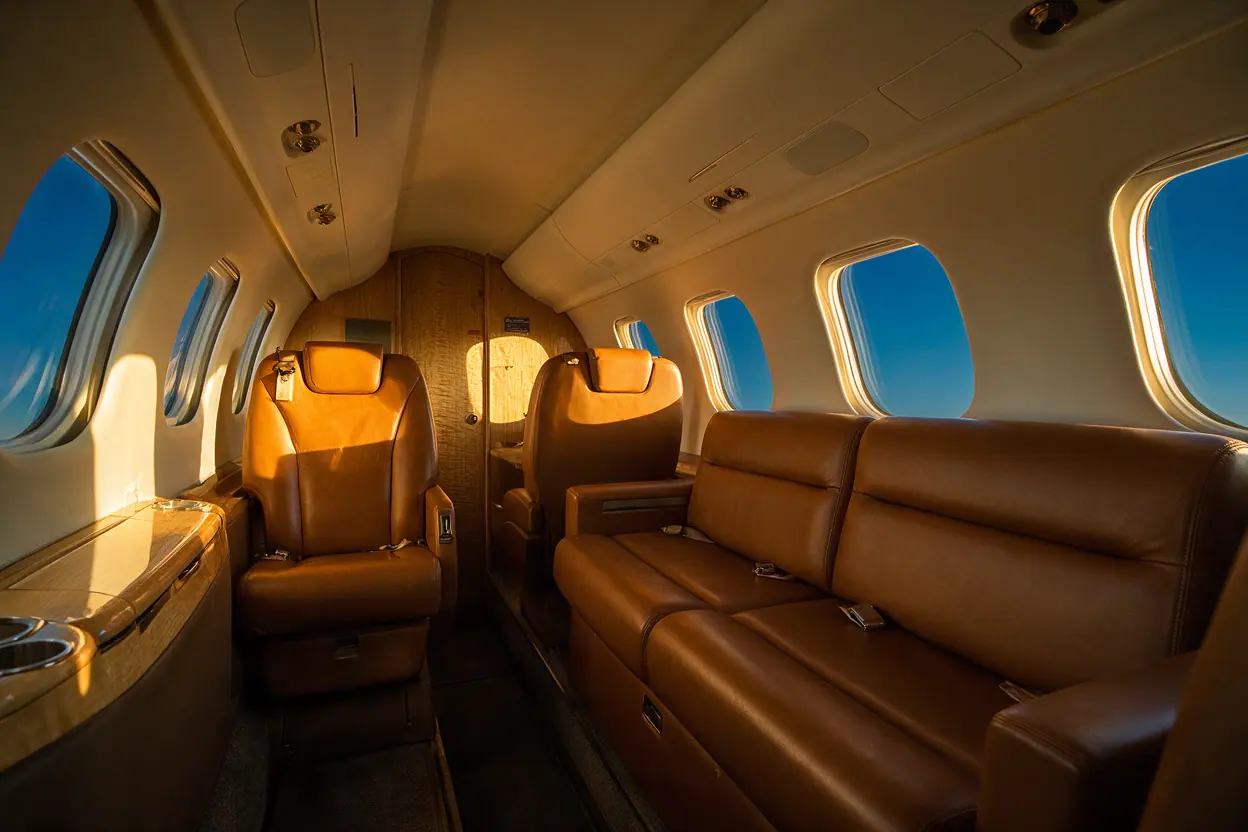
The light jet fits this route well because the leg sits inside its comfort band. A Citation CJ4 Gen2 or Phenom 300E covers 1,023 nautical miles with seven seats and a small, usable cabin, and the type flies it in roughly 2h 48m, so you land with more than half a tank if you want a return the same day. Light jets also reach Chicago Executive (KPWK), where the ramp is quiet and the drive to the northern suburbs is short. If your party is four or fewer and the trip is under four hours, the light jet is the sensible default.
The alternatives each buy something specific. The turboprop is cheaper, from $8,500, but the slower block time of 3h 53m and lower altitude wear on a working day. Midsize jets start at $14,500 and add stand-up headroom and more baggage. Super-midsize and heavy jets start at $18,500 and $24,500 and make sense for larger teams or a same-day turnaround with no fuel stop. On a half-continent leg like this, the jump from light to heavy is mostly cabin, not speed, because the heavy jet's block time is the same 2h 35m as the super-midsize.
Cessna Citation CJ4 Gen2
- 7 pax
- 451 kt speed
- 2,165 nm legs
Cabin size 4 ft 9 in tall, 17 ft 4 in long. Bags 71 cu ft.
Embraer Phenom 300E
- 7 pax
- 464 kt speed
- 2,010 nm legs
Cabin size 4 ft 11 in tall, 17 ft 2 in long. Bags 84 cu ft.
When demand peaks on this route
Chicago to Miami demand peaks around major Florida events and holiday weekends, and light-jet capacity tightens first. The last week of December through early January, plus the Miami boat show and race weekends, is when light jets get scarce, so a light jet booked for a Friday in that window may price closer to the top of its range or require a return on a different day. Leadership conferences, the art fairs in early December and the spring break stretch also pull tails south.
If your dates are fixed during a peak window, then book as early as your plans allow and lock the tail, not just the class. If your dates are flexible, then midweek departures and a Monday return are usually easier to source, and a light jet is available at a lower point in its range. The return leg is where the real difference shows: a Miami-based tail positioning back north can make a southbound leg cheaper, while a Chicago tail that has to wait in Florida carries the cost of that wait.
For a same-day out-and-back, then confirm the crew duty limit and the fuel plan before you commit. A light jet can fly a Chicago to Miami round trip with a meeting in between, but the crew's duty day sets the hard stop, not the aircraft. If your meeting runs long, then the departure time moves, and the operator may need to swap crews, which changes the quote.

Leaving Chicago
You can depart from Chicago Midway (KMDW) or Chicago Executive (KPWK), and the choice affects your morning. Midway has a 6,522-foot runway and sits close to the South Side and downtown, but you share the field with airline traffic and TSA lines. Chicago Executive has a 5,001-foot runway, lighter traffic and a shorter drive for the northern suburbs. Both handle light and midsize jets without issue on a normal winter day, though a warm, heavy takeoff from KPWK can be tight for a fully loaded large-cabin jet.
If your trip is international on the Miami side, then you will clear CBP at the arrival airport, so build that into your schedule. On domestic legs, no customs applies either direction. Winter is the main variable out of Chicago: a de-icing delay on the ramp can add time before you ever taxi. If your meeting is fixed, then an early departure gives you margin against weather.
Arriving in Miami
Miami-Opa Locka Executive (KOPF) is the usual business arrival, with an 8,002-foot runway and a short drive to the Design District, Wynwood and downtown. Miami International (KMIA) has a 13,016-foot runway and sits closer to the beaches and the port, but it is a busy commercial field and you will share the approach with airline traffic. For a Brickell or Coral Gables meeting, Opa Locka puts you at the curb with less ground time, while KMIA suits a beach or portside itinerary.
Ground time after landing is short at Opa Locka because the ramp is compact. If you plan to continue to the Keys or the Bahamas, then Opa Locka is also the practical staging point, and you would clear CBP there before the next leg. For a domestic arrival, step off and go.
| Field | ID | Rwy |
|---|---|---|
| Miami-Opa Locka Executive Airport | KOPF / OPF | 8,002 ft |
| Miami International Airport | KMIA / MIA | 13,016 ft |
| Chicago Midway International Airport | KMDW / MDW | 6,522 ft |
| Chicago Executive Airport | KPWK / PWK | 5,001 ft |
Comparable private jet routes for Chicago – Miami
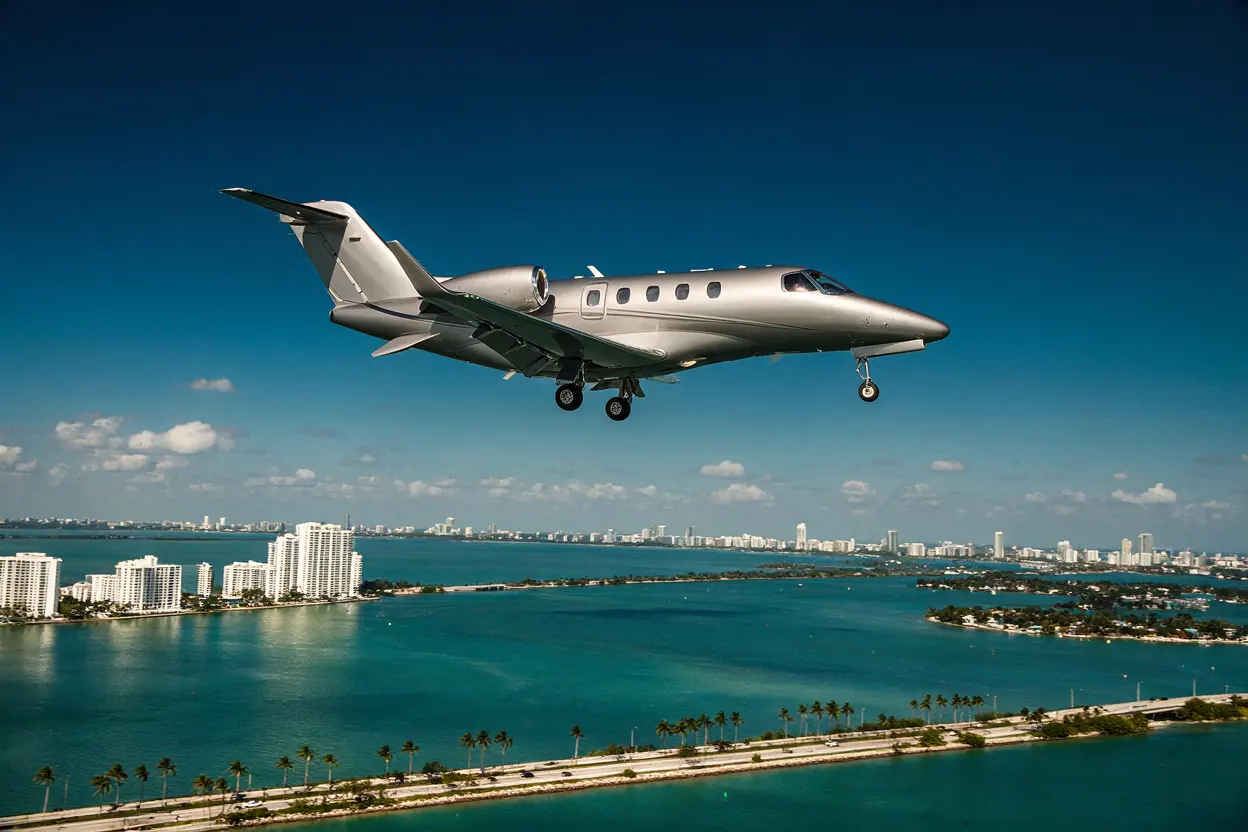
These 6 private jet routes cover 818 to 1,191 nautical miles, with one-way light jet estimates ranging $8,500 to $23,000.

This route’s FAQs
How long does a corporate jet Chicago to Miami flight take?
A light jet covers the 1,023 nautical miles in about 2h 48m nonstop. Midsize jets take about 2h 44m, and super-midsize and heavy jets about 2h 35m. Those are block times in still air. A winter headwind out of Chicago or a summer storm over Florida can add time, so plan your meeting around the arrival window rather than the scheduled block time.
How much does a corporate jet Chicago to Miami cost?
A light jet is estimated at $10,500 to $16,000 one way. The turboprop runs $8,500 to $13,500, midsize $14,500 to $21,500, super-midsize $18,500 to $26,000 and heavy jets $24,500 to $37,500. These are estimates, not quotes. The actual number depends on the tail, date, passenger count and whether the aircraft has to reposition to collect you.
Which Miami airport should a corporate jet use, Opa Locka or Miami International?
Miami-Opa Locka Executive (KOPF), with its 8,002-foot runway, is the usual business arrival and the shorter drive to the Design District or Brickell. Miami International (KMIA), with a 13,016-foot runway, is closer to the beaches and the port but is a busy commercial field. If your next stop is the Keys or the Bahamas, then Opa Locka is the practical choice for customs and staging.
Can I fly corporate jet Chicago to Miami and return the same day?
Yes, with limits. The flight is under three hours each way, so a morning departure and an evening return fit inside a normal crew duty day. A light jet with seven seats is the usual pick for a small team. The real constraint is the crew's duty limit and the time your meeting runs, so agree on a departure window rather than a fixed time.
What aircraft fly the corporate jet Chicago to Miami route?
The light-jet class includes the Cessna Citation CJ4 Gen2 and Embraer Phenom 300E, both seven-seat aircraft with about 451 to 464 knots cruise. The CJ4 Gen2 has a 2,165-nautical-mile range and the Phenom 300E 2,010. Both cover this 1,023-nautical-mile leg nonstop with reserves. Midsize, super-midsize and heavy jets are also available if you need more cabin space.
Does a corporate jet Chicago to Miami trip need customs?
No. Both Chicago and Miami are US cities, so a domestic leg needs no CBP clearance. If you continue from Miami to the Bahamas or another country, then you would clear CBP at Opa Locka before that leg. On the Chicago side, Chicago Executive and Midway differ mainly in traffic and surface time, not in regulatory formalities, for a domestic departure.